

TOP 10 TUESDAY: Villains in Musical Theatre

You can't have a great story without a solid antagonist, right? Well these notorious baddies are about as dastardly and ruthless as they come, but like many of the most compelling villains, it isn't just about how "bad" they are, rather how successfully they compel an audience to be drawn in by them, even begin to root for them at times. Here are my picks for the top 10 best muscal theatre villains; oh, and major plot points will be being discussed, so a courtesy SPOILER ALERT is in place, you have been warned...
-----
10. LITTLE SHOP OF HORRORS - Audrey II

Starting with the only non-mammalian entry to feature, Audrey II has built a reputation as everyone's favourite carnivorous alien plant, but what makes it particularly frightening is just how single minded and one-dimensional this extraterrestrial entity truly is. A self confessed "mean, green mother from outer space", Audrey II begins life in the musical as a withering, sad looking plant that was on the verge of being thrown out by Mr Mushnik. That is until the shy, unassuming young Seymour, having named the plant for the woman he loves Audrey, pricks his finger whilst lamenting its inability to grow, and the scent of his blood revitalises it, to the point where Seymour begrudgingly agrees to give it a few drops each day...but then every plant, when well nourished, is bound to grow!
And grow it certainly does, exploding from something resembling a miniature Venus fly trap to an absolutely gargantuan Goliath of greenery, and in the process demanding greater and greater offerings of human blood, flesh and bone, leading the previously morally upstanding Seymour to begin feeding the local townspeople of Skid Row, including Audrey's abusive boyfriend Orin the dentist, to this evil, albeit charismatic alien verdure, out of fear that it would consume him. This plant may well be terrifying, psychotic, with an appetite for you and me, but you just can't help but feel drawn to it.
9. WICKED - Madam Morrible
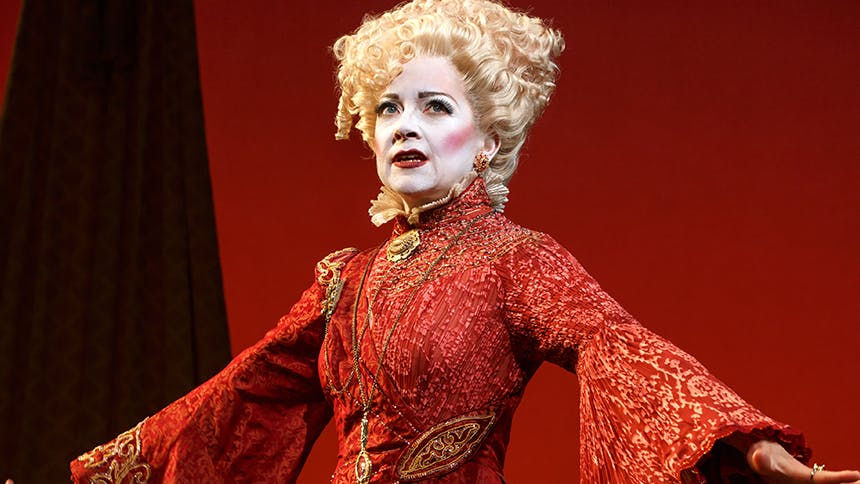
Some of the most captivating antagonists are those who, rather than being violent or aggressive, use the power of mental manipulation, playing the long game, and pulling the strings of their victims (and the audience) like a puppet; perhaps one of the best exponents of this is the cold, calculating and power-hungry headmistress of Shiz University Madame Morrible who, upon realising that young Elphaba has potent magical abilities at her fingertips, she immediately jumps at the opportunity, personally instructing her, abusing her influence as principal, and using her protégé's impressive talents to further her own political career. Initially believing Morrible's intentions to be honourable, Elphaba is all too quick to take up the opportunity to meet the Wizard, travelling to the Emerald City along with new best friend Glinda, however it quickly becomes all too clear what her true machinations are and flees, remaining in exile for the remainder of the musical.
Morrible's conniving nature is so deliberately masked that even we as the audience are taken in and completely fooled, as she hides in plain sight behind a facade of benevolence, generosity and supremacy, and nothing can prepare us for when her and the Wizard's intentions are made known. Once it is made known to Elphaba that the Wizard has no true power, this is when Morrible makes her move, using her influence over both the weather and the people of Oz, as well as the natural public distrust of Thropp due to her unconventional appearance, to spearhead a smear campaign, leading to the persecution of the innocent young witch. Though Morrible does eventually get her comeuppance at the hands of Glinda the good, the damage is long since done when this occurs, and we have to ask ourselves: was Morrible the true victor in this story?
8. SUFFS - Woodrow Wilson

The first ever broadway show to feature an all female and nonbinary cast, Shaina Taub's multiple Tony winning musical "Suffs", in which she also starred, tells of the trials and tribulations of the American suffrage movement in the 1910s. Led by trailblazing feminist icon Alice Paul, and her merry band of Suffs, they fight back against the patriarchy, and the societal imbalance that had developed over the prior centuries, in an attempt to secure votes for women. The biggest spanner in the works for the hundreds of thousands of women trying to secure the vote is the inherently anti-feminist traditionalist president Woodrow Wilson, believing that a woman's place is in the home, supporting their husbands; after all, "why would ladies vote? We provide all that they need!"
Having the character played by a woman (originated off-broadway
by Grace McLean) is the perfect move, as it makes the misogyny attached to the character feel almost comical and satirical, whilst also maintaining the generally perceived villainy of the character, somehow coming off as both an amusing caricature and a figure with whom you genuinely despise. This is most notably highlighted in the act 1 number "Ladies", during which Wilson chauvinistically expresses his admiration and adoration of the women who make up half of the country's population, brushing them off as weaker, less important, and incapable of handling issues of the day. And though the Suffs emerge victorious in the end, that certainly doesn't stop Wilson, ever the political pragmatist, from claiming it as his own, backing suffrage only when it was deemed politically advantageous, which adds that extra layer of slime and sleaze to the character.
7. NATASHA, PIERRE & THE GREAT COMET OF 1812 - Anatole Kuragin
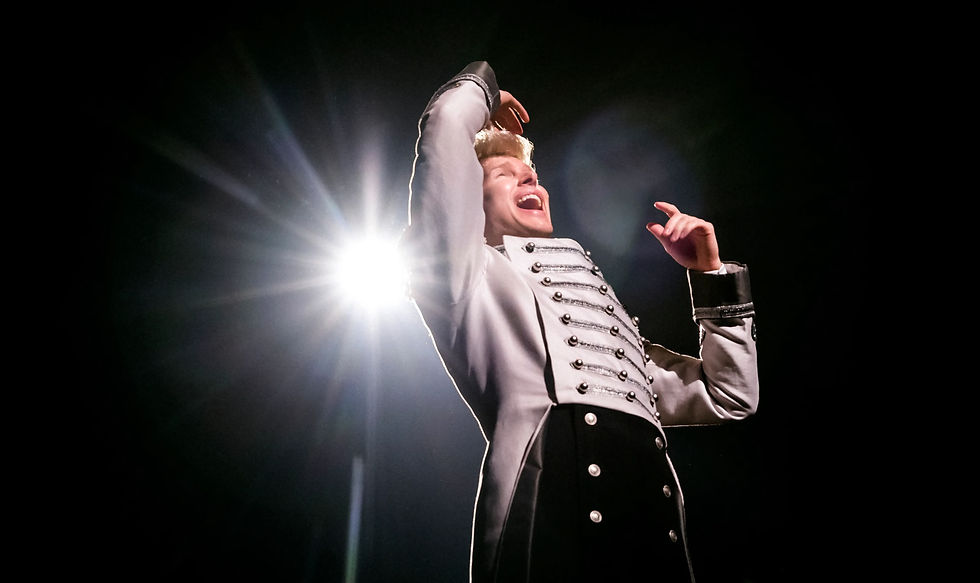
One of the cornerstones of great Russian literature, Leo Tolstoy's "War & Peace" has no shortage of antagonists throughout its span of approximately 575,000 words and over 1,000 pages. Whilst the whole novel is never going to be adapted to the stage without it taking up several days worth of runtime, Dave Malloy did the next best thing, and took a 70-page segment of volume 2, part 5 of the book, and turned it into a 150-minute long sung-through musical, which focusses on Natasha Rostova, her engagement to Prince Andrei Bolkonsky, and simultaneous relationship with one of the more memorable antagonists Anatole Kuragin. The brother in law to the titular Pierre Bezukhov, Kuragin is a classic Casanova/Don Juan, charming, hedonistic, and will stop at nothing to get his way.
During a night at the opera between Natasha, cousin Sonya, and godmother Marya, Anatole enters the auditorium late, charms his way into Natasha's heart, and exploits her naivety for his own pleasure and without a thought for the consequences for either. What she doesn't know is that he is already married, but in spite of this, the pair plot to elope, with Natasha abandoning her engagement to Prince Bolkonsky. Upon learning that Kuragin is already tied to another, Natasha falls into deep despair, feeling her life had been ruined; Pierre later jumps to her rescue, confronting Kuragin, demanding he leave Moscow, and consoling the distraught Countess Rostova. Whilst Anatole does show some degree of remorse after being dressed down by Bezukhov, his actions still almost lead to the destruction of a young woman's reputation for his own selfish desires, making him a compelling yet deplorable antagonist.
6. THE LION KING - Scar

The green eyed monster known as envy is one that can be truly toxic, and can make people do unspeakable things in the name of getting their way. When your brother is older, stronger, more respected and with more authority than you, this is naturally going to cause friction and contention in the family; this is particularly true of power-hungry Scar, brother of the king, whose claim to the throne of Pride Rock practically vanishes overnight with the birth of his nephew Simba. Rather than accepting his place gracefully, Scar, a master manipulator, instead plots to have both Mufasa and his son taken out of the picture, putting Simba in grave danger after his halfwit Hyena minions trigger a stampede in the gorge, and manipulating Mufasa into jumping in to save him, stabbing him in the back in the process. This all leaves the king dead, and Simba easily talked into leaving Pride Rock, leaving Scar to claim the throne for himself.
What the petty younger brother doesn't count on is the fact that Simba, in his exile, grows from a cub into a fully grown lion who, upon being found and given the push in the right direction by childhood best friend and eventual lover Nala, returns to Pride rock to claim the throne and challenge his uncle. Scar's biggest strength eventually turns into his ultimate downfall, and his self service in many ways is his undoing as, once a voice of authority and respect for the cackle of hyenas, attempts to throw them under the bus to save his own skin. This is a move which, naturally, doesn't go down particularly well, ending with the hungry hyenas turning on their former master, and making him their next meal.
5. MATILDA - Miss Trunchbull

None of us particularly enjoyed school did we? Well just be thankful that you didn't have to content with, arguably, the most terrifying, torturous headmistress to ever walk the earth, a woman whose name strikes fear into every child (and adult) who hears it, and whose mere presence is enough to reduce even the most hardened of us to a blubbering mess. Miss Agatha Trunchbull is a heartless, cruel and controlling head of Crunchem Hall, believing that every child is a "maggot" to be controlled, and that keeping them afraid builds character. That is until one Matilda Wormwood sets foot inside the school, and dares challenge the Trunchbull's reign of terror after witnessing far too many students and teachers alike suffering at the hands of her authoritarian, cruelty-driven regime.
Although her character is considerably, at times amusingly exaggerated, Miss Trunchbull represents the typically frightening authority figure from one's childhood, we have all had that teacher whose classroom we feared entering. After all when you're that young, the world can be a scary place, especially when venturing out of one's family bubble for the first time and into the world of education. Part of what makes the Trunchbull so formidable is how one-dimensional she is, physically imposing, sadistic and ruthless in nature, and completely devoid of remorse or empathy, Roald Dahl and Tim Minchin have combined rather superbly to create a marvellously monstrous caricature of a villain.
4. HAMILTON - Aaron Burr

Yet another antagonist driven by political pragmatism and unabashed self-interest, Aaron Burr is the antithesis of the eponymous Alexander Hamilton in so many ways, the silent stoicism to Hamilton's outspoken, fiery nature, and never one to make his personal or professional intentions known, focussing instead on cautious opportunism. Though not initially particularly villainous, being portrayed more as a friend and rival to Hamilton than an enemy, it is his inability to establish any sense of principle or ideology that proves to be his downfall, after his long term competitor backs Thomas Jefferson in the presidential campaign, stating that "Jefferson has beliefs, Burr has none". This is quite inevitably followed up by a series of letters between the pair, ultimately ending in a duel at Weehawken, New Jersey, during which Alexander is fatally shot by Burr, cementing his status as "the villain in our history".
Though there is an argument that King George could be considered the main villain, his presentation is more of a comic sideshow, a "nudge nudge" to the Brits and their self-deprecating nature, rather than being someone we root against. Of course Burr himself isn't an inherently evil, malicious figure, far from it in fact, rather he lets his own ambition and self interest get the better of him, making him more a tragic antihero than a truly deplorable villain, and the way in which events transpire and deteriorate between him and Hamilton one could almost argue was an inevitability. What sets him apart as the primary antagonist is how he acts out of selfish desire for power and progression, rather than in the country's best interests.
3. LES MISÉRABLES - Javert

Few characters are quite so dogged or single minded as police inspector Javert, after all it takes real conviction and stubbornness, or perhaps just sheer lunacy, to spend the best part of 2 decades chasing down a man who had more than served his sentence, for the most peripheral of crimes no less. The year is 1815, and Jean Valjean is at the end of a 19 year sentence for stealing a loaf of bread to feed his poor sister and her family (5 for the crime itself, the rest due to attempted escapes), a considerably disproportionate punishment by any standards. Javert though is ever present, breathing down his neck at every turn until that sentence is served in full, so when Valjean breaks parole and starts a new life, prompting Javert to swear that he will never stop searching for the elusive jailbird.
Javert is another example of an antagonist not motivated by any morally questionable means, but rather his unyielding dedication to the word of the law, a personal and professional code by which he has lived all of his life, so he feels duty and honour bound more than anything, rather than acting out of malice or hatred for Valjean. Arguably his biggest flaw is his inability to see the bigger picture, and his staunch dedication to upholding the law blinds him to the more moral implications, or the clear goodness that fills Valjean's heart, even going so far as to condemn the mayor for choosing kindness over incarceration for Fantine, after she acts in self defence against an overly enthusiastic punter. His epiphany and internal conflict during the second act serves as the characters climax, as Valjean's goodness wins out over Javert's professional and legal stubbornness, and he realises that the rigidity of his moral code is fundamentally flawed.
2. SWEENEY TODD - Judge Turpin

The desire for revenge can be a terrific motivator, especially when one is going through difficult times, such as having been wrongfully imprisoned or exiled as a result of an abuse of judicial power, as is the case with the titular demon barber in Stephen Sondheim and Hugh Wheeler's musical "Sweeney Todd". Having just returned from a 15 year exile from an Australian penal colony, with sailor Anthony Hope the one to aid him on his journey, London barber Benjamin Barker has finally returned to the English capital, kept going with the notion of vengeance against the evil, cold hearted Judge Turpin who, after having removed Barker as an obstacle, proceeded to take his wife Lucy for himself, raping her in the process, and adopting the pair's young daughter Johanna, whom he later vows to marry after she has come of age. His motivations and methods are so despicable, so devoid of basic humanity, that he is an instantly detestable figure, making him the perfect villain.
With the aged but revitalised Barker having renamed himself as Sweeney Todd, in attempt to avoid detection, he immediately lays out his plans to deliver Turpin his comeuppance, returning to the upstairs flat he once occupied, now situated above Mrs Lovett's failing pie shop. Todd manages to ensnare the unwitting Judge into his newly set up barbershop, however after Hope bursts in expressing to marry Johanna, whom Turpin believed was to marry him, he storms out and vows never to return. In a fit of rage and bloodlust, Todd begins to "practise on less honourable throats", with his victims baked into pies sold by Lovett, in a lucrative business venture for the pair. Todd does eventually manage to manipulate Turpin into returning to complete his shave, in the hope that Johanna will be drawn in by his newly groomed facade...that is until Todd finally gets his man, ending the life of the menacing magistrate; Turpin's undoing is arguably his cruelty, elitism, and delusions of grandeur.
1. HADESTOWN - Hades

There is a reason the stories and characters from ancient Greek mythology have endured the centuries, surviving the harshest of global conflicts and extinction level events to still be enthralling audiences today, even becoming the foundation for one of the most popular broadway and west end musicals in recent years. First surfacing two decades ago, Anaïs Mitchell's musical masterpiece "Hadestown" is not only a brilliant interpretation of these millennia-old tales and figures, but provides a profound allegory for both capitalism and climate change, spearheaded by the tyrannical titular lord of the underworld. Hades is man who has lost his way somewhat since his marriage to Persephone has lost its spark, replacing caring for his wife with building foundries and laying power grids, and perpetually enslaving the souls trapped in Hadestown, whom he keeps busy with the promise that building the wall will "keep out the enemy" of poverty.
After years with his workers operating under his iron fist and dominating boot, the arrival of young artist Orpheus, with the intention of rescuing poor girl Eurydice from being trapped in hell for all eternity, sees Hades' grip on his kingdom begin to slip away once Orpheus' song awakens the workers from their blind submission to their work, and though Hades' love for Persephone is rekindled, bringing the world back into balance, the king's thirst for power and control isn't something he is likely to give up. However, he has a trump card up his sleeve; after the poet requests that Eurydice be granted permission to leave, a personal dilemma ensues, and he comes to the conclusion that the only way for him to win is to "give them the rope" to "hang themselves". The story ends in tragedy for Orpheus and Eurydice, and the fact that Hades manages to retain control, ultimately sees him emerge as the victor. This is a rare win for the villain, and makes for perfect tragic storytelling, and the intellect, complexity, and unexpected humanity are what help the man who conducts the electric city top this list.
-----
Did I miss your favourite? Which musical theatre villains do you find the most compelling? Let me know in the comments, or via my Instagram page.


Comments