

Feature: TEN ON TUESDAY - Off-West End VenuEs (September 2026)
It's safe to say that, when deciding what shows to see in London, the majority of people, especially the more casual theatre goers, will not likely look much past the glitz and glamour of the 40 theatres that make up the west end. The truth is, our nation's capital is home to anywhere between 240 and 300 different theatrical spaces, so if you're only looking in the west end, you're barely even scratching the surface as to what you can experience. Here are ten picks of venues beyond the west end, based on production quality, comfort, accessibility and overall vibes
Click images of each theatre to be taken to the venues' respective websites to find out more...
-----
1. SOUTHWARK PLAYHOUSE - Southwark

We kick things off with one of my favourite UK venues, and two for the price of one, as these intimate venues often operate as a single entity. First opening in 1993, Southwark Playhouse is situated around Elephant & Castle, with the Borough location at Newington Causeway, and Elephant at Dante Place, and only a ten minute walk between the two. It has since become a popular testing ground for new or developing shows, with high profile musicals such as "Operation Mincemeat" and "The Curious Case of Benjamin Button" having had early engagements at Southwark prior to their subsequent runs elsewhere. It has also hosted major stars in its more recent productions, such as Gemma Chan in the Timberlake Wertenbaker play "Our Ajax", "Glee" star Kevin McHale in Sondheim's musical "The Frogs", and the upcoming premiere of the Steven Sater and Duncan Sheik musical "NERO" featuring broadway favourite Andrew Barth Feldman.
From the moment you walk into either venue, it feels warm and inviting, with an unapologetically independent feel, and staff who genuinely seem happy that you are there. Each has its own unique personality, with Elephant's fixed thrust stage and Borough's pair of more versatile spaces, but both have plenty to love about them, as well as both venues being fully accessible, in terms of physical specs and the assistance offered whilst at the venue. Whether you are attending the shows, or just want to pop in for a coffee or a beer, Southwark Playhouse is easily one of the most individual, chilled out venues you can hope to attend.
2. BRIDGE THEATRE - South Bank

Next to one of London's newest, and arguably most highest profile off-west end theatres, the Bridge is a versatile space that can operate within proscenium, thrust or in-the-round parameters, and in its 9 year history has already build a name for itself as a premier producing house. The venue was developed by Nick Starr and Nicholas Hytner as a home for the London Theatre Company, and though many of its productions tend to remain in place due to the unique nature of their staging, such as the immersive stagings of both "Guys & Dolls" and "A Midsummer Night's Dream", each with a standing pit in and among the action, it has started branching out lately, with its recent production of "Into The Woods" becoming the first show produced by the Bridge to successfully transfer to the west end.
The theatre is situated right by the Tower Bridge, with one of the most open and welcoming foyer areas of any London venue, with a cafe that does both great cakes and baked goods, and a wide variety of alcoholic drinks if you're after something stronger. Where it really comes into its own though is in accessibility, with step free access to all levels, and reconfigurable wheelchair spaces, as well as hearing loop equipment, ear defenders, and content warning cue sheets for those who need them among others. It is always a treat to return to the Bridge Theatre, who are fast establishing themselves as not only visionaries in production, but front runners in terms of customer care.
3. ROYAL COURT THEATRE - Sloane Square

And now to one of the older venues on this list, but also certainly one of the most comfortable, many will associate the Royal Court Theatre with it's most famous export "The Rocky Horror Show", which first premiered in 1973 starring Tim Curry and Richard O'Brien, who would both go on to reprise their roles both on broadway and in the 1975 film adaptation. The theatre first opened in 1870, but was later demolished and rebuilt in its current guise in 1888, featuring two separate performance spaces, the larger 380-seater Theatre Downstairs, and the more intimate 85-seat house Theatre Downstairs. After it was repurposed from being a theatre, the property was used as a cinema during the mid to late 1930s, subsequent to which it closed down due to WW2 bomb damage.
Since it reopened in 1952, with a reduced seating capacity from its original 891, the Royal Court has become an international frontrunner in producing new modern drama, with plays such as John Osborne's "Look Back in Anger" and Jim Cartwright's "Road" shaping the venue's creative vision, and more recently the UK premiere of Kimberly Belflower's Tony nominated play "John Proctor Is The Villain" breathed new life into the theatre as a trailblazer of modern writing. In addition, its characterful front of house areas, cushy leather seats, and pop up bookshop make this one of the most unique and enjoyable overall experiences in a theatre.
4. NATIONAL THEATRE - Embankment
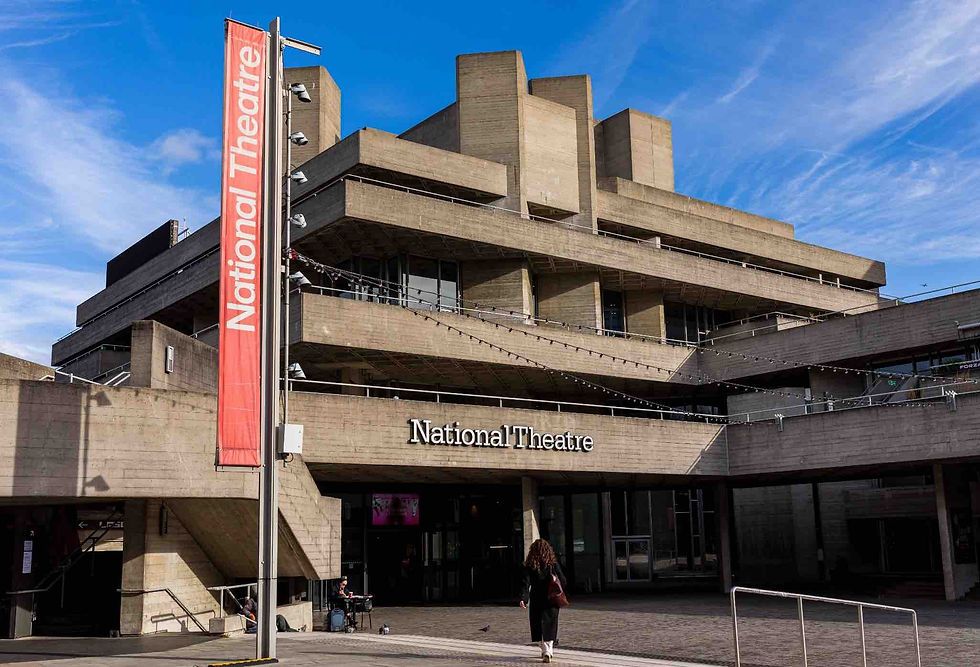
In the year when this institution of British theatre celebrates its 50th anniversary, what better way to honour its place in the annals of history than to include it in my ten favourite off-west end theatres. Though the company's overall history is far older, with the initial proposal of such an institution being put forward by Effingham Wilson back in 1848, it wasn't until 1963 when the idea finally became a reality, with the National Theatre Company being founded by Laurence Olivier, and performing at the Old Vic for the earliest years of its existence. It finally moved into its current permanent home in 1976, overlooking the south bank of the River Thames, originally with just the Olivier and Lyttelton auditoriums, later adding the Dorfman in 2013 after a large scale refurbishment.
The National has since become a leading producing house in both London and the UK in general, with many productions staged having life beyond their initial or developmental runs here, including "War Horse", "Hadestown", and "My Neighbour Totoro" among many others. In addition to this, the building itself, though brutalism isn't an architectural style towards which many gravitate, the interior, its features and functionality are where it really hits its stride, including one of the best selections of theatre books and scripts in the UK, and several quality dining options, as well as areas to come and study, write, read, or generally unwind in between shows or after work. This is a London venue that is always worth the trip.
5. YOUNG VIC - Waterloo

Now on to two venues separated only by a stretch of road and half their respective names, and we're going to start with the more recent addition to the London theatrical scenery. Though the Young Vic Company has existed for since the mid-40s, it didn't open its own premises until almost 25 years later, finally moving into its Waterloo home just down the road from its older sibling in 1970. Originally a part of the National Theatre prior to its own official HQ opening, and set up as "an experimental workshop for authors, actors and producers”, the Young Vic finally became an independent body in 1974, and has remained a vital part of the life breath of the UK theatre scene for the past 50 year, with bold, thought-provoking new works that challenge, inspire and entertain audiences young and old.
The Young Vic is another enormously inviting venue, and though its low profile, ad hoc exterior is fairly unassuming, once you walk in your entire perception shifts, with its quaint, vibrant open plan front of house areas that make you feel right at home. You can grab a coffee or a beer with a friend, sit and do some remote work, or just admire the various posters of upcoming productions that adorn the balconies. And much like other entries on this list, the adaptable auditorium is delightfully versatile, often operating with a thrust style stage, but also with in the round capabilities, and this, combined with the intimate nature of its 400-seat capacity, means the Young Vic rarely has a bad seat in the house.
6. OLD VIC - Waterloo

As the name may suggest, this is not only one of the oldest theatres in London, but it's by far the longest standing in this article as, in spite of countless rebuilds over the years, the Old Vic has been in almost constant operation for over two centuries, serving as an initial headquarters to the National Theatre (as described earlier) in the 1960s and 70s, and also having a shared history with Sadler's Wells, with renowned producer and manager Lilian Baylis overlooking both institutions in the 1910s - 30s; her influence and legacy eventually led to the top tier of seating at the Old Vic being named in her honour.
Unlike its more modern counterpart, the Old Vic focusses more on a mix of new theatre and revivals of classics, such as the world premieres of "Groundhog Day" and "Just For One Day", as well as becoming the first theatre on the planet to stage the entire first folio of plays by William Shakespeare, over a nine year period between 1914–1923. And while obvious updates have been made to modernise the venue, in additions restorations made due to bomb damage during the second world war, it is still jam packed full of centuries worth of history, with everyone from Edmund Kean and John Gielgud to Vivien Leigh, Peter O'Toole, Alec Guinness and Maggie Smith having taken to the stage at this most venerable of theatrical cathedrals.
7. KILN THEATRE - Kilburn

Best known as the home of "Two Strangers (Carry A Cake Across New York)", one of the latest British exports to make it on broadway, the Kiln Theatre first opened its doors back in 1980, originally named the Tricycle Theatre, and is another that has been upgraded on several occasions, with its current iteration opening in 2018. The building itself, however, dates back to the late 1920s, when it was used as a meeting place for the Kilburn branch of the Friendly Society of Foresters, later as an air raid shelter and food distribution centre during World War II, and a local council advice centre in the years post-war. That was until Shirley Barrie and Ken Chubb, founders of the Wakefield Tricycle Company, converted the building into the permanent theatrical venue that we know today.
What sets the Kiln apart is its distinct community feel, as it regularly actively engages with locals in the borough of Brent, with outreach and creative learning programmes, as well as opening up its performance spaces to youth theatre, often from underrepresented backgrounds. That aside though, it's just a pleasant place to be, with its bars, wide range of sweet and savoury pastries, and on-site pizzeria providing stunning pre-show dining, and the refurbished auditorium that has enhanced overall visibility and accessibility, not to mention marvellous comfort from its 292 seats.
8. ROSE THEATRE - Kingston-upon-Thames

Though most venues on this list are either within or close to central London, the Rose Theatre does require something of a trek to get to, as it is situated out in Kingston-upon-Thames, and though you could easily float on up the river to get to this stunning theatre, a 40 minute train from Waterloo would likely be far, far easier. Only opening in 2008, the Rose was built with classic Elizabethan architecture in mind, with its auditorium designed with English renaissance playhouses in mind, however unlike other similar spaces, the Rose is specifically kitted out with far more spacious seating for maximum comfort. In spite of its capacity of 822, every seat feels close to the stage due to the thrust style auditorium layout, creating a surprising sense of intimacy.
Unlike many other Great London theatres outside of the main part of the city, such as the Wimbledon New Theatre and the Churchill Theatre in Bromley that focus more on visiting productions, the Rose also acts as a producing house, and has already drawn in some serious acting acumen, including performers like Celia Imrie, Mel Giedroyc, Michael Sheen and Dame Judi Dench. For the journey it takes to get out to Kingston, once you arrive you realise that it absolutely is worth the trek, especially if you're visiting this beautiful theatre that blends recent with renaissance spectacularly.
9. UPSTAIRS AT THE GATEHOUSE - Highgate

By far the smallest and most unassuming theatre to feature on this list, what this fringe venue lacks in size it more than makes up for in its heart, quality of programming, and how it endears itself to audiences. Situated, as its name would suggest, upstairs at the Gatehouse pub in Highgate, this tiny 122-140 seater space has fringe written all over it. Though it has existed in its current iteration since 1997, its history stretches back another century, having operated in various guises since 1895, including as a music hall, a jazz & folk club, and a cinema. Over the past 30 years, the Gatehouse theatre has become a hotbed of fringe theatre activity, with everything from Jason Robert Brown and Sondheim musicals to new shows like "In Clay" and "Moominvalley in November" performing in this hidden gem of a theatre that is fortunately becoming less and less hidden.
What makes this venue unique among others in this article is that it doesn't operate primarily as a theatre, meaning you can nip down to the pub after the show and grab a drink, often for an hour or two after whatever you're watching has finished. And since the venue is a typical fringe theatre, complete with a blank black floor/curtains and moveable seating, that gives directors terrific scope for maximising its space, and staging imaginative, bold productions that stand out. Where. the Gatehouse stands out though is through its consistency, stable long term management, and often higher production values, making it the perfect post-fringe festival theatre for further life beyond a show's initial run.
10. ALMEIDA THEATRE - Islington
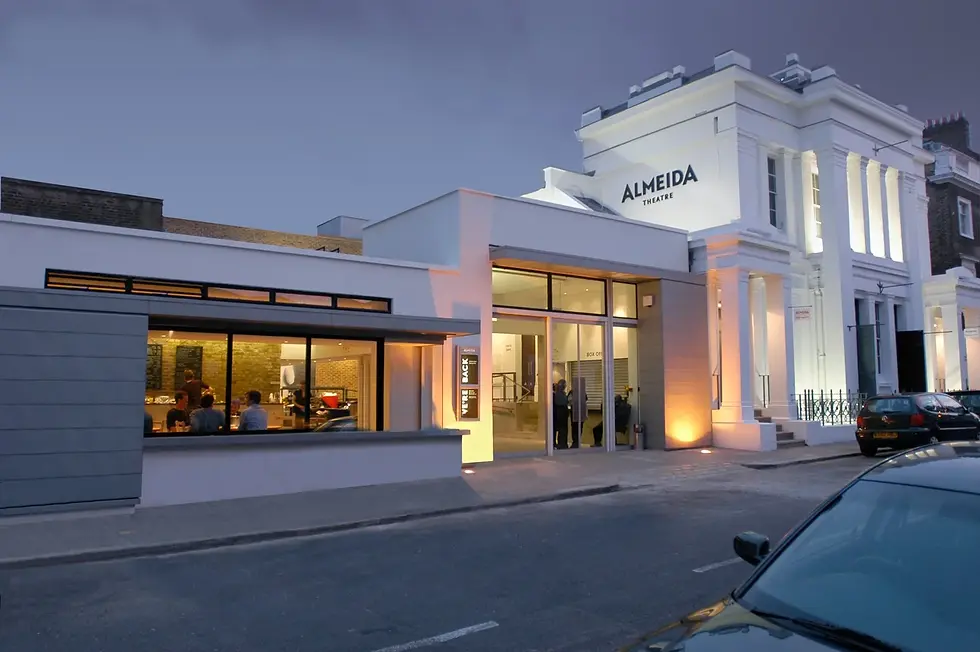
We finish with perhaps one of the most prestigious and influential producing houses in the whole of London, if not the country in general, the 325-seater Almeida Theatre has been hosting Islington audiences for over 4 decades, first opening its doors as a theatre in 1982 after having operated in various other guises for almost a century and a half. It was founded by Lebanese director Pierre Audi after he acquired the then derelict building in the late 70s, and became the theatre's first artistic director until 1989, when he was replaced by Jonathan Kent and Ian McDiarmid. It was under this pairing that the Almeida began to really come into its own, becoming one of the UK's leading producing houses, after Audi initially developed it as a home of more experimental new theatre.
Since the venue staged the Howard Barker play "Scenes from an Execution" in 1990 starring Glenda Jackson, the Almeida has gone from strength to strength, maintaining a reputation for innovative, influential theatre that broadens the mind, and has audiences and critics alike purring. From its all-white exterior that blends regency style architecture with more minimalist modern aesthetic, to its intimate, adaptable 325 seat auditorium, and hugely welcoming, bright, characterful front of house areas that whet one's appetite brilliantly. Whether it's a Shakespeare play, something new like the recent premiere of Ava Pickett's "1536", or the recent revival of "Spring Awakening", you are bound to find something you love at this most beautiful of theatres.
-----
Did I include your favourite? With so many theatres to choose from, I was bound to miss a few important ones, so let me know below (or via Instagram) if you would like a second part...


Comments